Bernie Borges [00:00:00]:
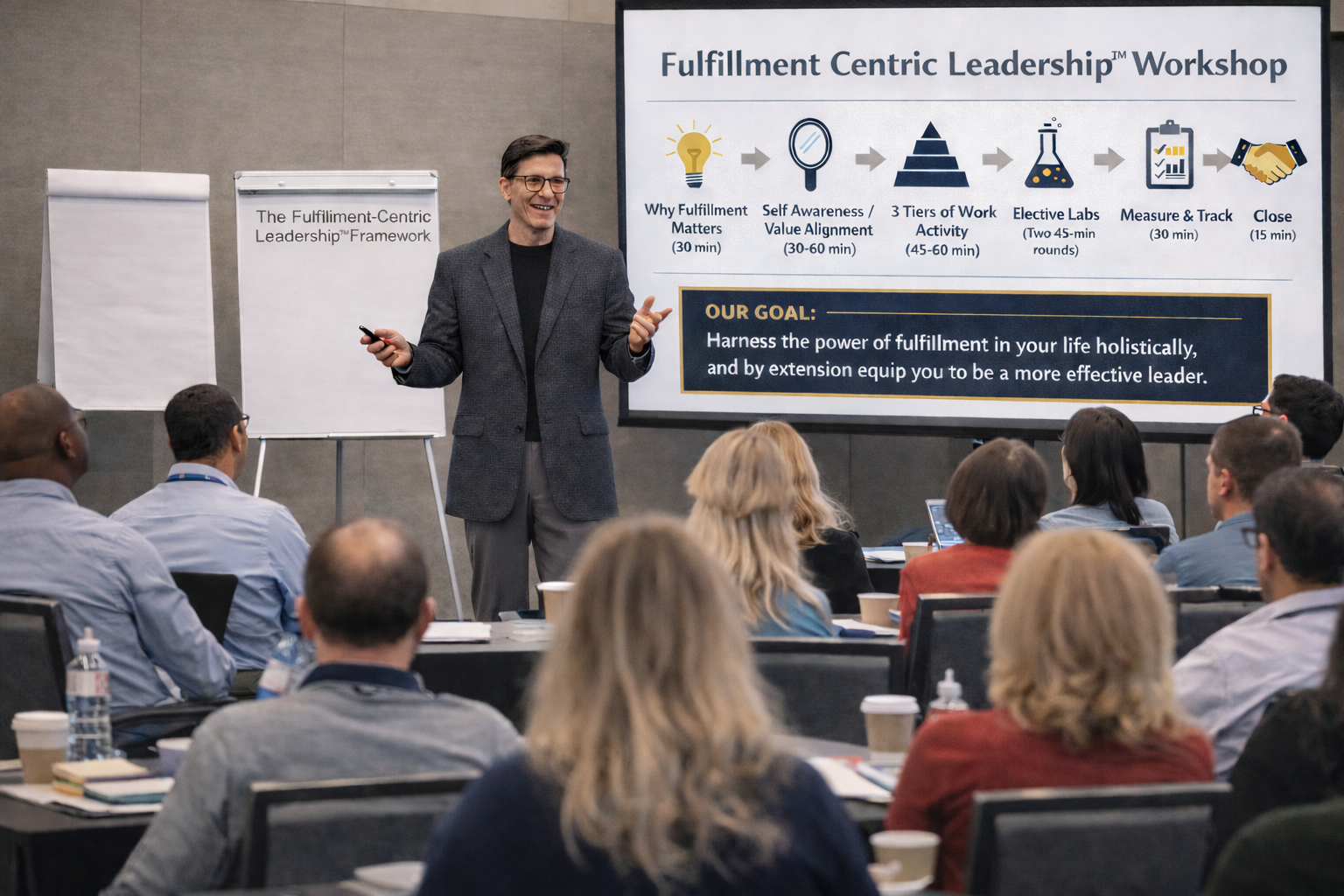
If you’re a leader, chances are you’re asking yourself, how do I keep my people engaged, motivated, and performing in the middle of an AI revolution that’s changing everything? Well, today I’m going to present my case for why the answer has nothing to do with technology and everything to do with leadership. Quick story. In the course of my day-to-day business activity, I regularly present my Fulfillment-Centric Leadership method to leaders. Recently, I received a very interesting piece of feedback from an executive who attended one of my presentations. And I’m paraphrasing, but the essence of the feedback was this: I see the merit of your approach to boosting engagement through a fulfilled workforce, Bernie. But right now, we’re not primarily thinking about turnover or engagement. We’re thinking about the impact of AI on our employees, the impact on their morale, and ultimately on their performance. How does your framework address that? Honestly, I thought that was a great question.
Bernie Borges [00:01:09]:
Not because it challenged my fulfillment-centric leadership framework. It, it didn’t, but because it revealed something deeper. And the more I thought about this, the more I believed the following. Is true. AI does not replace the need for fulfillment-centric leadership. It actually increases the need for it. That’s the big idea that I want to explore with you today. And if you’re a little skeptical, first of all, I’m not surprised, but I hope that you’ll stay with me as I explain my thinking, and I welcome your comments.
Bernie Borges [00:01:42]:
Hey, if this is your first time on my channel, welcome. I’m Bernie Borges, CEO of Fulfilled at Work Academy. Now, here’s what I believe. If you are a leader, or if you support leaders, the conversation about AI is not only about technology. It’s also about trust. It’s also about fear and about meaning and about confidence and about adaptation. And ultimately, it’s about the human experience of change. And that is exactly where fulfillment-centric leadership lives.
Bernie Borges [00:02:19]:
So let’s start there. We all know that AI is changing work. That part is obvious. It’s changing how work gets done. It’s changing workflows, expectations. It’s changing the speed of business. And in some cases, it’s even changing what employees believe their future might look like. But here’s what I think many organizations are missing.
Bernie Borges [00:02:43]:
Employees are not all experiencing AI the same way. Some people are excited about it. They see opportunity. They see efficiency. They see creativity. They even see a chance to work smarter and faster. Others feel uncertain. They’re asking, what does this mean for my role? What new skills do I need? And what’s expected of me now? And then there are employees who feel threatened.
Bernie Borges [00:03:15]:
They may be wondering, will I still be relevant? Is my value shrinking? How’s this going to impact my job? Am I being replaced? This is why this conversation matters. Because from a leadership perspective, AI is not just a conversation about technology adoption. And it’s not just a productivity conversation. It’s a human experience conversation. Now, that may sound counterintuitive. So let me explain. What leaders often see is kind of like the tip of an iceberg above the surface. They’re the visible parts of AI transformation, the tools, the automation, the implementation plan, the efficiency gains.
Bernie Borges [00:04:02]:
But below the surface, are the things that actually determine whether AI adoption succeeds or stalls. Things like trust, clarity, confidence, meaning, and adaptability. And if employees don’t trust leadership, they may resist the AI thing that is being introduced. And if they don’t have clarity, they may disengage or hesitate. And if they don’t feel confident, They may opt out, stay silent, or underperform. And if they lose a sense of meaning, they may begin to wonder where they fit and whether their work still matters. And if they’re not supported in adapting, then what could have been a moment of transformation becomes a moment of disconnection or, worse yet, dejection. This is why I believe the real AI challenge is not technical, it’s human.
Bernie Borges [00:05:04]:
And that’s why fulfillment-centric leadership belongs in this conversation. Now, I want to be clear about one thing. I am not positioning myself as an AI teacher. And as a side note, I’m an avid user of multiple AI tools. And anecdotally, I know people who are struggling with the adoption of AI in their work. Not because of the technology, but because of the impact on their humanity. So my human lens in this conversation is really more heightened as a result. So I’m not here to train people on how to be a prompt engineer or how to use different AI tools.
Bernie Borges [00:05:42]:
That is not my lane. My lane is helping leaders lead people through change. My lane is helping leaders at organizations create the conditions where people can stay connected, adaptive, and of course, fulfilled, even as the workplace evolves. That’s what makes this moment so relevant to the fulfillment-centric leadership story. Because when work changes quickly, people need more than a strategy deck. They need leadership. They need leaders who can reduce fear, who can create clarity, who can preserve meaning, and they need leaders who can build adaptability. That to me is the practical value of fulfillment-centric leadership in the age of AI.
Bernie Borges [00:06:34]:
So let’s unpack that. First, let’s begin with probably the elephant in the room, and that’s reducing fear. Leaders can’t pretend that fear isn’t real. Man, it’s real. Even in organizations where people are outwardly curious about AI, there’s often a quieter question that’s underneath the surface. And it sounds something like this: What does this mean for me? A fulfillment-centered leader doesn’t dismiss that question. They address it with honesty, transparency, and empathy. Second, creating clarity.
Bernie Borges [00:07:13]:
People need to understand how expectations are changing. They need clarity around their roles, responsibilities, development, and if their job is even still relevant. And you know, in times of change, a lack of clarity can create anxiety. Clear leadership creates steadiness. Third, preserving meaning. This one’s huge. If AI takes over more tasks, then leaders have to help people reconnect to the uniquely human value that they bring to the job. Things like judgment, creativity, discernment, empathy, relationship building, and purpose-driven contribution.
Bernie Borges [00:07:59]:
The question isn’t only what can AI do? The deeper question is, What becomes even more important for humans to do with AI? And fourth, build adaptability. The future of work belongs to organizations that help people grow with change rather than freeze in the face of it. Adaptability isn’t just a skill issue. It’s a leadership issue. People adapt better when they feel safe. They adapt better when they feel seen. They adapt better when they trust the environment that they’re in. This is why I believe fulfillment is not a soft idea in the age of AI.
Bernie Borges [00:08:43]:
It’s a strategic stabilizer. In fact, the more technology accelerates change, the more important human-centered leadership becomes. And that brings me to the 5 pillars that are the foundation of my broader work. You know what they are. Health, fitness, career, relationships, and legacy. I think AI touches all 5 of these pillars. Let’s go through them one by one. Health.
Bernie Borges [00:09:10]:
AI can increase stress, cognitive load, and always-on pressure if leaders are not intentional. In terms of fitness, and by that I mean energy and stamina and confidence, I don’t mean winning any kind of medals. AI requires people to keep learning and adapting. Without burning out. In terms of career, and this might be the biggest one in the workplace, employees want to know, do I still have a future here? Do I have an opportunity to grow? Am I still relevant? In terms of relationships, AI can either isolate people or free them up for more meaningful collaboration. And leadership makes the difference. And in terms of legacy, Leaders have to ask a bigger question. What kind of workplace are we building as technology advances? What values are we reinforcing? And what human impact are we creating? That’s why I don’t see AI as separate from employee engagement or fulfillment.
Bernie Borges [00:10:13]:
I see it as one of the clearest reasons why fulfillment-centric leadership matters now more than ever. Because AI may reshape work, but leadership shapes how people experience that change. And that experience matters. It matters for engagement, for culture, for trust, and ultimately it matters for performance. And yes, it matters for whether organizations actually realize the value that they hope AI will deliver. So if you’re a leader listening today, here’s the question that I leave you with. As AI continues to change the workplace, are you only thinking about the tools, the technology, the implementation, or are you also thinking about the human experience of that change? On the surface, this may sound like a rhetorical question, but it’s not. Because organizations that thrive won’t just be the ones who know how to use AI.
Bernie Borges [00:11:12]:
They’ll be the ones with the most human-centered leadership harnessing the potential of AI. They’ll be the ones where people still feel valued, still feel seen, feel connected to meaningful work, feel capable of growing, and still feel like they matter. This is the heart of fulfillment-centric leadership. And in my view, AI doesn’t make that framework. Any less relevant. It makes it essential. Now, maybe you agree with me and maybe you disagree. This is a big conversation and I welcome your comments to continue the conversation.
Bernie Borges [00:11:51]:
I really do. And if this conversation resonated with you, I’d love for you to share it with a leader, an HR professional, or someone that’s navigating change in the workplace. And if you’re exploring how to lead in a way that protects both performance and humanity in your workplace, that’s exactly the conversation that I care about most. And I offer a complimentary 20-minute strategy session. If you wanna do that, the link is in the show notes. I’m Bernie Borges, your fulfillment architect. I’ll see you on the next episode. And remember, if you’re not subscribed to my channel, tap or click that subscribe button now if you wanna see me in your feed in the future.

 Be your executive coach