
If you’re leading an AI transformation initiative, I have a question for you. How’s it going?
It’s well documented that 70% to 90% of AI transformation initiatives have failed. In fact, the MIT Media Lab/Project NANDA released a new report that found that 95% of investments in gen AI have produced zero returns.
On the surface, it’s easy to jump to the conclusion that the technology is not ready for prime time. That the promise of AI is not really what the hype machine says it is.
I think AI is absolutely ready for prime time. However, I wonder if leaders are ready?
Maybe leaders should reframe their thinking, starting at the top. Rather than viewing AI transformation as an IT or technology-first initiative, maybe it should be viewed as an HR-first initiative?
Truth be told, I don’t expect the HR community to sign up for this. That said, I’m willing to bet the HR community can get behind the intent behind my suggestion.
My point is that AI transformation is a people-first initiative, and a technology initiative second.
Let’s not over complicate this. We are overhauling how work gets done. Until now, people have been doing the work, even if we’ve leveraged tools for decades. Gen AI promises to deliver a new level of work output, surpassing previous norms. But, people still need to master the tools to get work done.
So, let’s reframe this as a human-led AI strategy in four parts. Here they are.
Reduce Fear
Leaders need to address the uncertainty of an AI program early and honestly. It’s real. Ignoring it only erodes trust. Start conversations that address the fear. You don’t need to have all the answers. Just call it out and give people a safe space to share their questions and concerns.
Create Clarity
Leaders need to identify the priorities, expectations, and the path to progress, even if they don’t have all the answers. It’s okay for the path to progress to be an evolving one. Roles will inevitably change. Discuss what that could look like. And, discuss it as often as you need to.
Preserve Meaning
Leaders should remind their teams of their human value, purpose, and contribution that cannot be replicated by AI. Their relationships, critical thinking and nuanced insights can make or break an outcome.
Build Adaptability
Leaders need to identify opportunities for people to learn, adjust, and grow through change. Demonstrate permission for shared learning experiences so the team doesn’t feel unnecessary pressure to become AI experts overnight.
The bottom line is that human-led AI transformation succeeds when people feel safe, informed, valued, and ready.
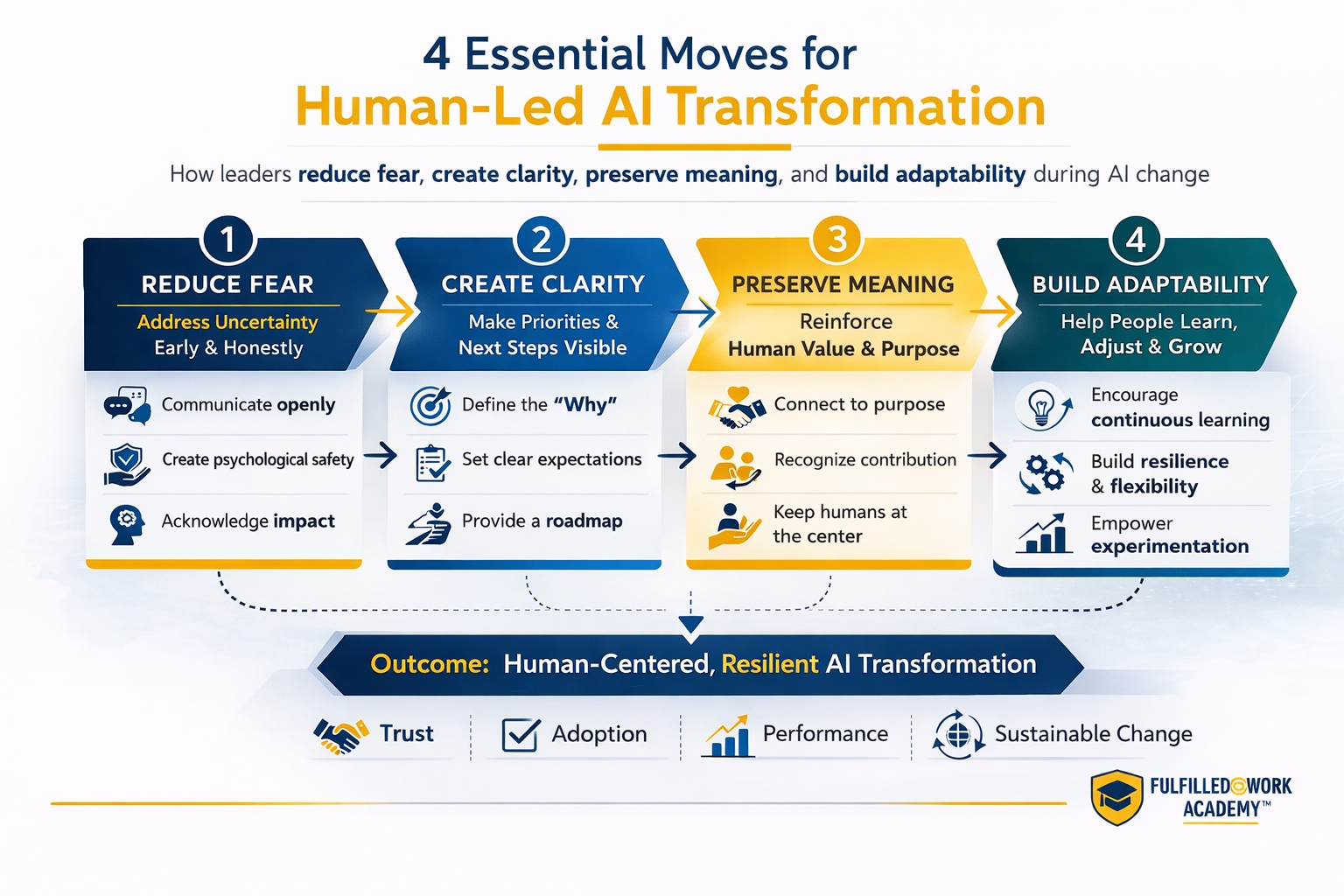
These four elements to human-led AI transformation are an over-simplication of a complex challenge. And, that’s my point.
Treating AI transformation as a technology-first initiative has resulted in a 90%-plus failure rate. Maybe, another way to look at it is that your organization has more to gain than to lose with the human-led approach. Even if HR isn’t the lead role, you can tap into their knowledge and guidance. They are in the business of people.
I was inspired to address this topic in episode 278 of the Life Fulfilled Podcast where I unpack this topic and invite leaders to reframe their thinking.
If this resonates, share it with a leader you know going through this. If you want to explore what this could look like in your organization, schedule a complimentary 20-minute strategy call with me.