

There is a moment many people experience after a layoff that nobody talks about. It’s not the moment you update your resume. It’s not the moment you start networking. It’s the moment you walk into a room full of people, someone asks what you do, and you don’t know what to say.
Jess Smith knows that moment well, because she’s lived it.
As a former HR executive with leadership roles at Meta and Amazon, and now the founder of Reframing HR, Jess has navigated transformation from every angle. She has planned reductions in force. She has led teams through them. And she has been impacted by one herself. In Episode 284 of the Life Fulfilled podcast, we had a meaningful conversation that I think matters deeply right now, as AI continues to reshape the workforce at a pace most people are not emotionally prepared for.
What came out of that conversation was not just a story about career resilience. It was a masterclass in what it means to lead with humanity when the ground is moving under everyone’s feet.
The Identity Trap
When Jess was laid off from Meta, she described the disorientation of having her professional identity suddenly detached from any company, title, or team. She was scheduled to attend a conference just days later, and the thing that unsettled her most was a simple question she knew was coming: What do you do?
That question felt terrifying. And that tells us something important.
When our identity gets too tightly bound to our job title, a layoff doesn’t just disrupt our career. It can feel like it disrupts who we are. This isn’t a weakness. It’s a very human response to a culture that rewards us for tying our worth to our output and our status to our employer.
But the truth is that your title is an expression of your work. It’s not the measure of your worth.
This distinction matters enormously, especially right now. AI isn’t just eliminating roles, it’s accelerating the pace at which roles evolve, expand, and disappear. Leaders who have built their entire sense of self around their current function or title are going to feel that far more intensely. And their people will too.
The sense of fulfillment, grounded in health, relationships, purpose, and what you are building over the arc of your life, is precisely what keeps a person anchored when their professional landscape shifts. I will come back to that.
What Leaders Do When They Are Impacted Too
The morning Jess received the layoff notification, the first thing she did was call everyone on her team.
Think about that for a moment. She had just learned she was impacted by the layoff. She was processing her own uncertainty. And yet her immediate instinct was to reach out to her people, the ones who were also impacted, and the ones who remained.
That is not a leadership tactic. That is a leadership character trait.
What Jess described is something I see consistently in fulfilled leaders: the ability to hold your own experience while still showing up for others. Not suppressing your emotions. Not pretending the situation is fine. But choosing to lead with empathy even when you are in the middle of the same storm.
She offered reference letters. She connected people to her LinkedIn network. She encouraged those who stayed, knowing that “survivor’s guilt” in a post-layoff organization is real and often underestimated.
This is human-centered leadership in practice. And it is what earns lasting trust.
The ANCHOR Framework: A Tool for the Post-Transformation Moment
One of the most practical contributions Jess brought to this conversation is what she calls the ANCHOR Framework. Born from leading five organizational transformations in her career, the framework addresses something most leaders overlook: what happens after the disruption.
The announcement gets all the attention. The real work happens in the weeks that follow.
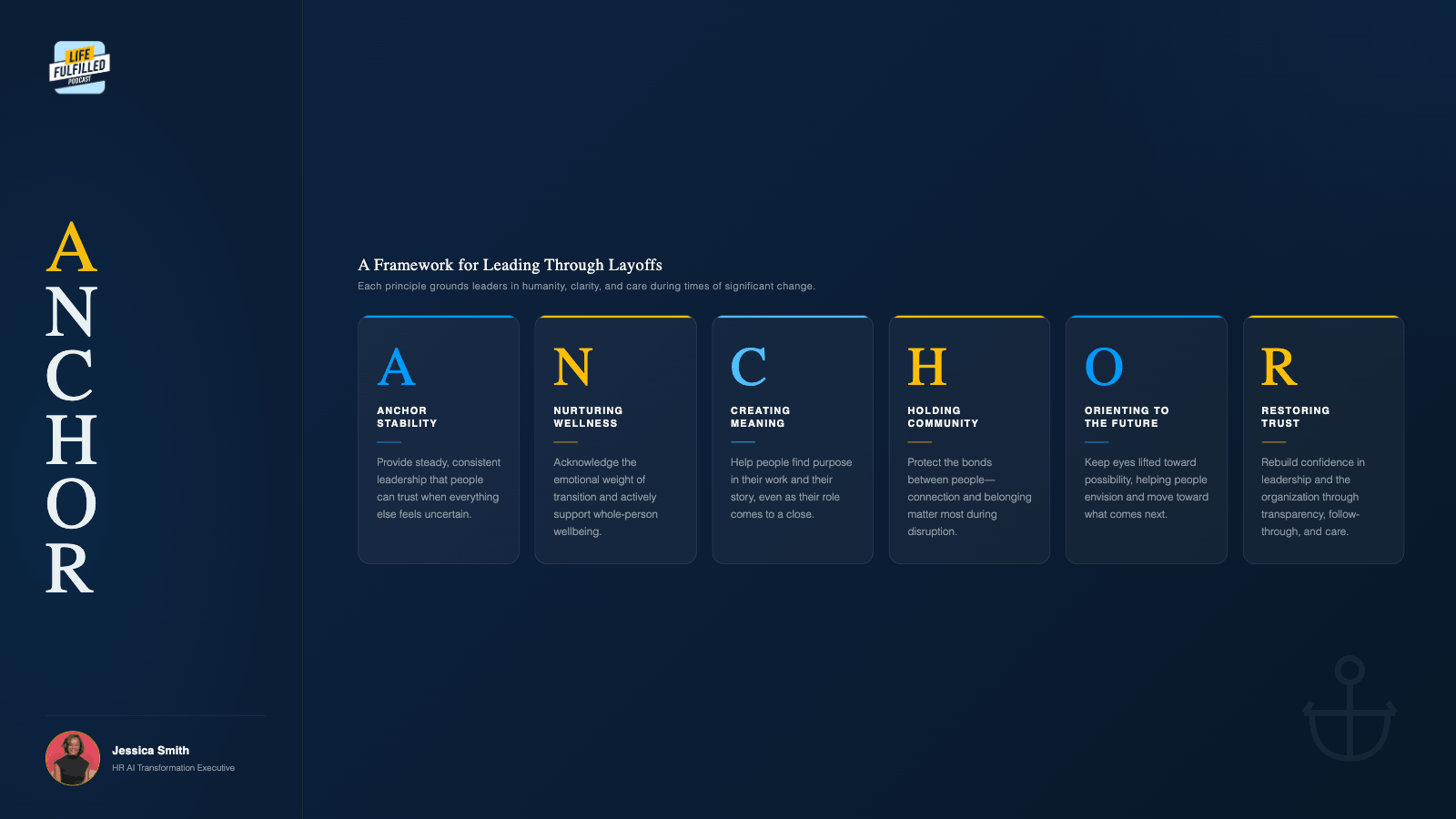
Here is a brief walk through each principle:
A — Anchor Stability. Be predictable. People don’t need certainty in uncertain times, they need consistency. Tell them what you are going to do, do it, and tell them again. That reliability becomes the anchor.
N — Nurture Wellness. After major changes, people are exhausted. Leaders who model rest, such as taking a walking meeting, actually unplugging on PTO, give their teams permission to do the same. Wellness is not a benefit. It is a leadership signal.
C — Create Meaning. Help people reconnect to why their work matters and how their role fits into the path forward. This isn’t about spin. It’s about clarity and purpose.
H — Hold Community. Isolation amplifies disruption. Protecting the bonds between people, whether through ERGs, team rituals, or simply creating intentional space to connect, keeps culture from eroding in the wake of change.
O — Orient to the Future. People need to see the path ahead. Not just that there is one, but how they fit into it and how they can grow within it.
R — Restore Trust. This isn’t optional. If trust isn’t rebuilt after transformation, all the productivity gains from the restructuring will dissolve. Trust comes back through consistent action, not reassuring words, but repeated follow-through on commitments.
What strikes me most about the ANCHOR Framework is how directly it addresses the human dimensions of change that standard change management often misses. This isn’t about communications plans and town halls. It’s about what people actually need to feel safe, connected, and capable of moving forward.
The Five Life Pillars and Why They Matter Here
In our conversation, I connected Jess’s layoff experience to the five life pillars that form the foundation of Fulfillment Centric Leadership: Health, Fitness, Career, Relationships, and Legacy.
A layoff, when it hits, touches every single one of them.
Health takes a hit when anxiety disrupts sleep and mental steadiness. The stress response is real and physical, not just emotional.
Fitness either becomes a lifeline or falls away. Jess’s story is instructive here, she was already going to the gym the morning she received the Meta layoff notification. That routine was not incidental. It was protective.
Career shifts from a source of stability to a question mark. The confidence required to pursue the next chapter has to be deliberately cultivated, not assumed.
Relationships are tested. Some work relationships will fade. Others will deepen. And the people at home, as Jess shared when her kids asked “what are you going to do now, Mom?” are absorbing the energy of what is happening too.
Legacy may be the most underestimated of the five in a moment like this. But Jess put it best: if you lead through this period thinking about how you want to be remembered on the other side of the AI hype cycle, that question alone will shape the quality of every decision you make.
A layoff doesn’t have to be a collapse across these five pillars. It can, if navigated with intention, become a reset. A recalibration. A chance to rebuild on a stronger foundation.
Reinvention Is Not a Strategy — It Is a Decision
Perhaps the most memorable chapter of Jess’s story is what she did after the layoff. She didn’t immediately begin a structured career pivot. She asked herself a simple question: What is something I’ve always wanted to do but never gave myself time for?
For Jess, the answer was Zumba.
She flew to New York, got certified over a weekend, and refusing to wait three to six months for a teaching opportunity the way the certification program suggested, she applied everything she had learned building scale at Amazon and Meta to launch her own cardio fitness business. She taught at Soho House. She built a network of twenty instructors across six locations. She was, by her own account, the fittest she had ever been in her life.
This is not just an inspiring story. It’s a data point about what becomes possible when someone stops defining their value by their last employer.
Jess eventually returned to executive HR work. But she walked back into that world more whole, more confident, and more clear on who she was independent of any company name or title on a business card.
That is the real reinvention. Not the career move. The identity shift.
On Using AI to Reclaim Your Voice
There is an irony worth naming. For many people, AI is part of the disruption that led to their layoff. And yet AI can also be a genuinely useful tool for people rebuilding after one.
Jess and I talked about this directly. When confidence is shaken, it can be hard to see your own value clearly. What AI can do, fed with your experience, your accomplishments, your career arc, is help you zoom out. It can reflect patterns back to you that you might not see from the inside. It can help you find language for the value you carry.
It will not define who you are. But it can help you articulate it more clearly when you need it most.
The goal is not to let AI replace your voice. The goal is to use it to reclaim it.
What Leaders Should Take From This
Whether you are leading others through a transformation or navigating your own, the through-line from this conversation is the same.
Fulfillment is not a reward you receive after you survive disruption. It’s the foundation you build before disruption arrives, so that when it does, you know who you are underneath the title.
Protect your voice. Do not let your last role become the ceiling for your next chapter. And as Jess put it so well: sometimes the path forward is not just about you. Pouring into others in a difficult season keeps you engaged, keeps you purposeful, and has a way of filling your own fulfillment tank at the same time.
That is a leadership lesson worth carrying into whatever comes next.