

Bernie Borges | The AI Trust Audit | Life Fulfilled Podcast
287

Ep 287 The AI Trust Audit: 5 Questions Every Leader Must Ask

Navigate AI rollouts effectively by conducting an AI trust audit. Uncover fears and boost your team’s engagement and trust.

Most leaders treat AI transformation like a software update. They send an email, hold a town hall, then wonder why their best people are quietly quitting or openly pushing back. The real issue isn’t the technology. It’s the uncertainty. It’s a lack of trust. In this episode, I introduce the AI Trust Audit: five specific questions you can ask your team right now to uncover the fears they’re not telling you, and how to pivot that anxiety into genuine engagement.

This episode is for leaders at every level who are navigating AI rollouts and sensing something is off, not with the technology, but with the people. If your team’s language has quietly shifted from “I’m excited about this” to “let’s see how it goes,” that’s not resistance to change. That’s a trust deficit. And it’s detectable, measurable, and fixable — before the damage is done.

The AI Trust Audit gives you a structured way to detect that erosion of trust before it metastasizes into disengagement, attrition, and resistance. It’s built around five questions, each designed to surface a different dimension of your team’s relationship with the change ahead — and to signal to your people that their experience of this transition genuinely matters to you.
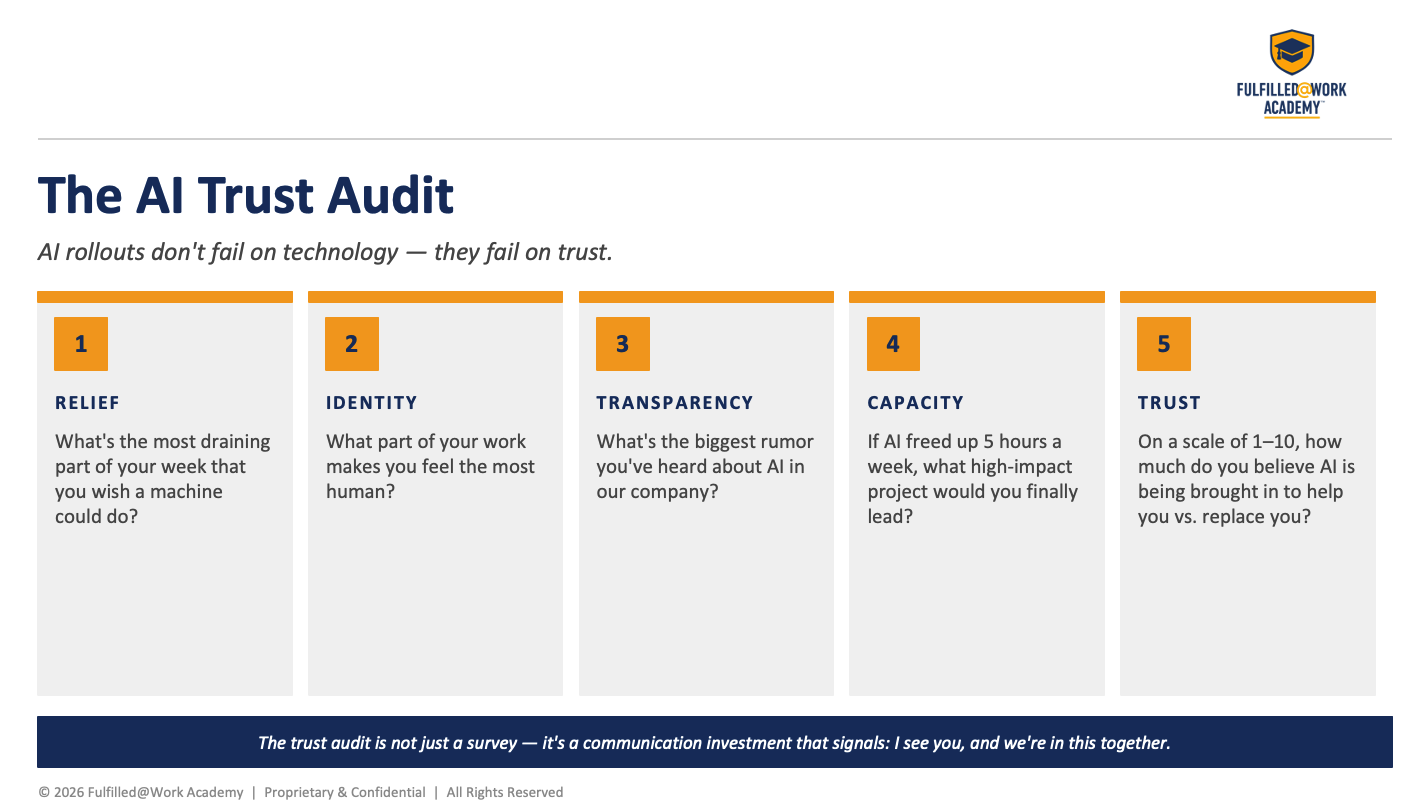
The AI Trust Audit | Bernie Borges | Fulfilled@Work Academy

5 Key Takeaways:

  • The Fear Tax Is Real: AI initiatives stall not because of poor technology or even poor communication, but because of unaddressed fear. When employees distrust the intent behind a rollout, that distrust becomes an invisible drag on performance — one that compounds quietly until it’s visible in attrition, disengagement, and resistance. Building trust before the rollout begins is not a soft priority. It’s a strategic one.
  • The Relief Question Reframes the Narrative: Asking your team what draining work they wish a machine could handle repositions AI as an ally before the rollout even begins. It signals that you’re thinking about making their work better, not just faster — and in the context of AI transformation, that reframe is everything.
  • Protect What Makes People Feel Human: The identity question — “What part of your work makes you feel the most human?” — isn’t soft. It’s strategic. If you don’t know what work fulfills each person on your team, you cannot design an AI integration that retains them. Fulfillment-centric leadership means building the rollout around what matters to people, not just what’s efficient.
  • Name the Rumors Out Loud: The transparency question takes courage to ask, but whatever your team is whispering in the hallways is already shaping their engagement with the rollout. Naming the rumors removes their power. In an AI transformation, radical transparency is the most direct antidote to the fear tax.
  • Make Your Team Co-Architects, Not Recipients: The capacity and trust questions shift your team’s orientation from “what am I losing?” to “what becomes possible?” When employees feel their input genuinely matters in shaping how AI is integrated into their roles, they advocate instead of resist. The trust score — a simple 1–10 — is a hard truth metric. A lot of sixes or below isn’t failure. It’s data that tells you exactly where to focus your communication and relationship building before and during the rollout.

Main takeaway: Your team is probably not afraid of AI. They may be afraid that the people leading them care more about the mandate to use AI than they care about them. The AI Trust Audit isn’t a one-time survey — it’s the beginning of an ongoing trust conversation and a signal to your team that you see them, you’re thinking about how this transition affects their work and their identity, and you’re not going to roll out AI and leave them to figure it out alone. That’s what fulfilled leadership looks like in the age of AI.

📅 Book a Complimentary Strategy Session with Bernie

Life Fulfilled Podcast host and Fulfilled@Work Academy CEO, Bernie Borges, offers a complimentary strategy session. Schedule yours here: https://calendly.com/fulfilled-at-work/employee-20-minute-strategy-call

Get the Life Fulfilled newsletter delivered to your inbox weekly. Some creators charge for their newsletter. My newsletter is free! Subscribe here. https://fulfilledatworkacademy.com/newsletter/

About Fulfilled Leadership:
The Fulfilled Leadership YouTube channel helps growth-stage leaders replace burnout, disengagement, and turnover with a fulfillment-based operating system without sacrificing results. If you are a founder, CEO, or leader running a company with 100–3000 employees, you are in the right place.

📣 Connect With Bernie Borges

👍 Like this video if you’re rethinking how you lead your team.
🔔 Subscribe to the Fulfilled Leadership YouTube channel
👉 Learn more at FulfilledAtWorkAcademy.com

Want to know more about Fulfillment Centric Leadership™?
https://fulfilledatworkacademy.com/ 

Connect with Bernie Borges
Website: https://fulfilledatworkacademy.com/
LinkedIn: https://www.linkedin.com/in/bernieborges/ 
Instagram: https://www.instagram.com/bernieborges/
TikTok: https://www.tiktok.com/@bernieborges  
Speaking: https://fulfilledatworkacademy.com/speaking/ 

“I record and produce my podcast in Riverside. I would use it even if I never recorded another episode. It’s an AI-powered platform for studio-quality recording (even on Zoom-style calls), plus ridiculously easy editing, transcription, and instant social clips. If you run webinars, record trainings, or want cleaner audio/video for meetings, take a look at my Riverside affiliate link.”

  • Bernie Borges, Host, The Life Fulfilled Podcast

Episode Transcript

Bernie Borges [00:00:00]:
Most leaders that I know are approaching AI transformation like it’s a software update. Hey, if that stings, hear me out. They send an email, they hold a town hall, and then they wonder why their best people are suddenly, quietly quitting or openly pushing back. The truth is, it’s not the technology that they’re afraid of. It’s the uncertainty. It’s a lack of trust. If you haven’t performed a trust audit, your AI rollout may already be failing. You just don’t know it yet.

Bernie Borges [00:00:35]:
I’m Bernie Borges, CEO of Fulfilled at Work Academy. In my work with leaders, I found this scenario to be pretty common. Today, I’m giving you five specific questions that you can ask your team right now to uncover the fears that they’re not telling you and how to pivot that anxiety into actual engagement. And if this resonates, subscribe to my channel for more content like this. Let’s get into it. When AI initiatives stall, leaders almost always blame one of two things. Resistance to change or poor communication. And both of those can be true.

Bernie Borges [00:01:29]:
But there’s another, deeper issue that’s usually underneath both of them, and it’s the one that nobody talks about. Now, maybe you already see where I’m going with this. For every percentage point of efficiency that AI promises, there’s what I call a fear tax. It’s that invisible drag on performance that accumulates when your team doesn’t trust the intent behind the technology. You can have the best implementation plan in your industry. But if your people believe, even quietly, that this rollout is about replacing them rather than equipping them, you’re not going to get the outcomes that you’re hoping for, full stop. The frustrating part is that fear is almost never spoken out loud. It lives in the hallway conversations, in the delayed responses to Slack messages, in the subtle shift from I’m excited about this to let’s see how it goes.

Bernie Borges [00:02:35]:
That’s what the trust audit is designed to detect. Not after the rollout, though, when the damage is done. Before now, the trust audit framework has five questions. And these five questions are designed to give you a complete picture of where your team actually stands, not where they say they stand. You can use them in one on ones small group settings, even as a pre initiative pulse survey. So let’s go through them. Beginning with question one, the relief questions. What’s the most draining part of your week that you wish a machine could do for you? Now, the leader’s intent behind this question is you want to understand where the energy leaks are.

Bernie Borges [00:03:22]:
Without this question, the employee’s perception is that AI is coming to take away the interesting parts of their job. The employee’s perception of this question is my leader’s thinking about how to make my work better, not just faster. And that reframe is everything. It positions AI as an ally before the rollout even begins. Question 2. This is the identity question. What part of your work makes you feel the most human? The leader’s intent is to identify the work that you have to protect and, and build around as AI takes on more tasks. The employee’s perception is my leader isn’t just thinking about efficiency, they’re thinking about what I care about.

Bernie Borges [00:04:12]:
This is core to fulfillment centric leadership, which is my neuroscience informed method. The goal of AI integration isn’t just to do more. It’s also to create space for, for the work that gets the results, that meets the business needs and fulfills people. And if you don’t know what that work is for each person on your team, you can’t design for it. It’s that simple. Question three, the transparency question. What’s the biggest rumor that you’ve heard about AI in our company? Now, the leader’s intent in this question is to flush out the silence traps, you know, the unspoken fears and that misinformation that runs underneath the surface. Now, this one takes courage to ask because you might not love the answers, but whatever they’re hearing in the hallways is already shaping how they’ll engage in the rollout, bring it into the conversation, address it directly.

Bernie Borges [00:05:15]:
Look, radical transparency is the antidote to the fear. Techs. Question four. This is the capacity question. If AI freed up five hours a week for you, what’s the one high impact project that you’d finally have the passion to lead? Now, the leader’s intent is to pivot the conversation away from what am I losing? To what becomes possible. And the employee’s perception is maybe there’s a future in this that actually involves me contributing at a higher level, a more meaningful level. This question does something subtle but really powerful. It makes your team member a co architect of the AI future rather than just a passive recipient of it.

Bernie Borges [00:06:05]:
And when people feel valued because their input really matters, they advocate instead of resist. Question 5. This is the trust question. On a scale of 1 to 10, how much do you believe this technology is being brought in to help you versus to replace you? Now, the leader’s intent is a hard truth metric. The employee’s perception is they’re probably surprised, but pleasantly that you’re asking this direct question. There’s not going to be any holding back. Here comes the truth. A score of 7 to 10 would be great, but if you get a lot of sixes or below, don’t look at it as a failure.

Bernie Borges [00:06:52]:
It’s data. It tells you exactly where to focus your strategy, your communication, and your relationship building before and during the rollout. The leaders who ask this question aren’t the ones who avoid difficult conversations. They’re the ones whose teams will run through walls for them because they’re willing to have those difficult conversations. So what do you do with the answers to the trust audit questions? You know, the most common mistake that I see after a trust audit is this. Leaders gather the data and then don’t close the loop. They ask the questions, they take a few notes, then they get busy and move on. And then their team wonders why they were even asked at all.

Bernie Borges [00:07:39]:
So here’s the protocol that I recommend. Acknowledge what you heard in your next team interaction and if possible, name it. Address the rumors directly. Even if you can’t resolve them, just address them. And naming them removes their power. So name them. If possible, use the capacity question answers to start a real conversation about role redesign. In fact, that’s what the next episode is about.

Bernie Borges [00:08:07]:
Episode 288. And then revisit the trust question scores about 30 days after the rollout. Measure the delta. That’s where your leadership impact is. Or not. You’ll find out. Now, the audit is not a one time event. It’s the beginning of an ongoing trust conversation.

Bernie Borges [00:08:30]:
How you implement this depends on whether you’re leading 10,000 people or 1,000 people, or 100 people or 10 people. The execution details might vary, but the intent and the outcomes should be the same. So here’s what I want you to walk away with from this episode. Your team is probably not afraid of AI. In fact, they might even be excited about it. But they might also be afraid that the people leading them aren’t paying attention to them or care more about the mandate to use AI than they care about them. The trust audit is not just a survey. It’s a communication investment in your team.

Bernie Borges [00:09:14]:
It’s also a signal. It tells your team, I see you. I’m thinking about how this transition affects your work and your identity. And I’m not going to just roll this out and leave you to figure it out alone. We’re in this together. That’s what fulfilled leadership looks like in the age of AI. If this resonates with you, episode 288 next week is going to take this even further. We’re going to talk about what happens after AI handles the drama draining work, and how you, as a leader, redesign roles around what actually fulfills your people.

Bernie Borges [00:09:55]:
If you want to go deeper right now, I offer a complimentary strategy session where we can look at how these concepts apply specifically to your team. The link is in the show notes. I invite you to subscribe so that you don’t miss the next episode and more like these on my channel. I’m Bernie Borges, CEO of Fulfilled at Work Academy. I’ll catch you on the next episode.

FREE DOWNLOAD

The Midlife Career Reboot Workbook

Subscribe & Listen on

Get the Midlife Fulfilled Podcast
Delivered to Your Inbox

Each episode is curated with love.

Your information is 100% secure and will never be shared with anyone. You can unsubscribe at any time.