
Let me say something that might be uncomfortable: your job title hasn’t changed. Your paycheck is still arriving. And yet with the advent of AI, if you’re honest with yourself, something feels different. Something feels… less.
That’s not a technology problem. That’s a meaning problem. And it’s one of the defining leadership challenges of this moment in history.
In Episode 280, I explore what I’m calling the “meaning gap,” the quiet displacement that’s happening to professionals everywhere as AI takes over the tasks they were known for. More importantly, I make the case for three human capacities that AI simply cannot replicate, no matter how sophisticated the model. If you lead people, this is a conversation you need to have with your team.
The Meaning Gap Is Real, and Leaders Are Missing It
We tend to think about AI displacement in dramatic terms. People losing jobs. Industries being disrupted overnight. But there’s a quieter, more insidious version of this happening right now in organizations everywhere.
“There’s a quieter displacement happening with AI, even when people keep their jobs. When AI starts handling the tasks people were known for, their sense of contribution simply declines. Even if their job title hasn’t changed, something feels less.”
Think about your best analyst. The one who built the reports everyone depended on. AI does much of that now. Or your top copywriter. The one whose emails always landed. AI does a solid version of that too. They’re still employed. But are they still fulfilled?
The meaning gap is what happens when the work that made someone feel capable and valued gets automated away, while the org chart stays the same. Leaders who don’t name this and address it will watch their best people quietly check out or walk out.
This Is an Identity Question, Not Just a Job Question
Here’s what makes this particularly tricky. When AI can do the work someone was hired to do, we tend to frame it as a productivity story or a skills gap story. We reach for reskilling programs and automation ROI metrics. But we’re missing what’s actually happening at the human level.
When AI can do the work you were hired to do, or most of it, that’s not just a job question. That’s an identity question. And it’s one of the most underestimated challenges of this AI moment.
People don’t just do work. They derive meaning, status, and a sense of self from work. When AI erodes that, it doesn’t show up as a performance issue, at least not at first. It shows up as disengagement. It shows up as a talented person who used to raise their hand now sitting quiet in meetings.
The leaders who understand this are the ones who will be able to retain and re-energize their people through this transition. The ones who don’t will wonder why morale is suffering even though nothing looks broken on the surface.
The Three Capacities AI Cannot Replace
So what does this mean for leadership? It means your job is to help people reconnect with the things that make them irreplaceable. Here are the three capacities I focus on in this episode.
1. Discernment
Discernment is not the same as data analysis. AI can process information faster than any human ever will. But discernment is the capacity to read a situation, weigh competing values, sense what’s true beneath the surface, and make a judgment call that reflects wisdom, not just calculation.
When a leader has to decide whether to push a struggling team member or give them grace, that’s discernment. When someone has to choose between the strategically “correct” move and the human one, that’s discernment. AI can inform that decision. It cannot make it.
2. Relational Intelligence
AI can simulate empathy. It can be programmed to be warm and encouraging. But humans provide empathy. If you have someone on your team who is exceptional at building relationships, tell them, because I promise you, they’re wondering whether what they’re good at still matters in an AI world.
Relational intelligence is the capacity to build real trust, navigate conflict with care, and show up for people in ways that land as genuine because they are genuine. A chatbot can mirror warmth. A person can feel it and extend it authentically.
This is especially important right now, because your team members who lead with relational intelligence are among your most at-risk for the identity crisis I described earlier. They’re watching AI generate content, crunch numbers, and answer questions. They’re wondering: where do I fit in? Your job as a leader is to tell them clearly and specifically.
3. Purpose-Driven Judgment
Purpose-driven judgment is the capacity to connect decisions to something bigger, to the mission, the people being served, the values that define the organization. It’s what separates a manager who executes from a leader who inspires.
AI can optimize for stated objectives. It cannot question whether those objectives are the right ones. It cannot feel the impact of a decision that affects real people’s lives. That weight and the responsibility that comes with it, is inexplicably human.
Your Call to Action
I want to leave you with something concrete, because that’s what this framework is about. Action. Not ideas.
“Think about one person on your team whose discernment, relational intelligence, or judgment has been on display recently. Find a moment this week to tell them specifically what you saw, what it meant, and why it matters, in a way that AI never could.”
That last phrase is not a throwaway line. It matters deeply. AI can generate a compliment. It can even make a compliment sound specific and heartfelt. But when you were in the room, and watched them actually navigate something hard, take the time to name what you saw and why it matters. That lands differently. That’s human recognition. And it has the power to re-anchor someone’s sense of identity and contribution in ways that no technology can touch.
Final Thought
The conversation about AI and work tends to get hijacked by two extremes: panic about job loss, or endless optimism about productivity gains. What gets lost in the middle is the human experience of working alongside AI, and the very real identity shifts that are happening right now, in your organization, among your people.
As a leader, you have a choice. You can manage the transition as a technology project. Or you can lead through it as a human challenge. The leaders who choose the latter, naming the meaning gap, honor the capacities that make people irreplaceable, and recognize their people in ways that only a human can. Those are the leaders their teams will remember.
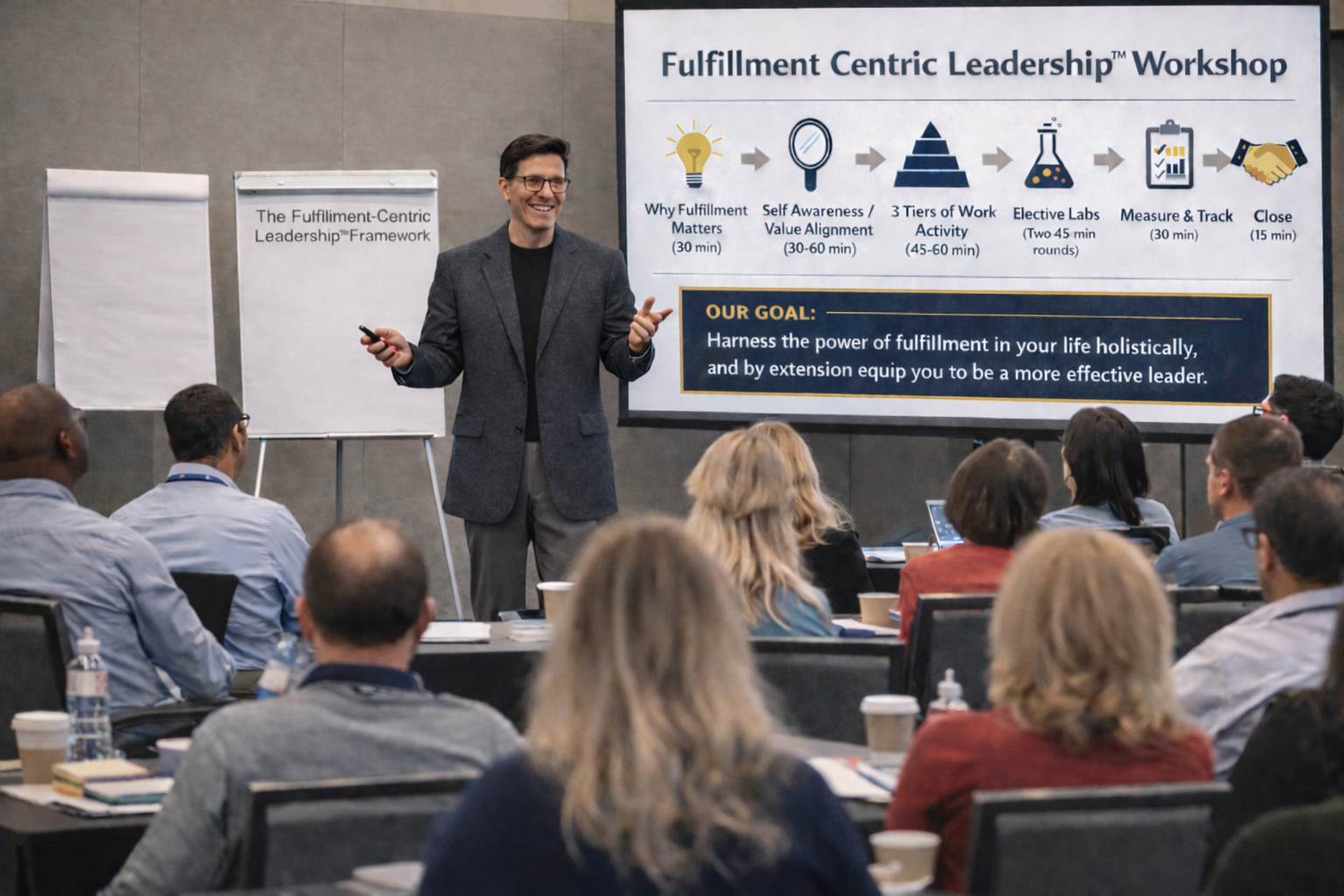
That’s what Fulfillment Centric Leadership™ looks like in practice. Not just performing well, but leading in a way that helps people thrive even when the world is shifting beneath their feet.
If this resonates, share it with a leader you know going through this. If you want to explore what this could look like in your organization, schedule a complimentary 20-minute strategy call with me.