Human Led AI Transformation Role Design | Bernie Borges | Fulfilled@Work Academy
288

Ep 288 How Leaders Can Redesign Work for AI: The Human Dividend

Discover how leaders can redesign work for AI to enhance creativity, relationships, and meaningful contributions in the workplace.

Most leaders launch AI with a promise of efficiency. Fewer leaders ask the more important question: efficiency toward what? In this episode, I introduce the Human Dividend: the leadership opportunity that opens up when AI removes repetitive, draining work and creates space for the work only humans can do; judgment, creativity, relationships, meaning-making, and contribution.

This episode picks up where the AI Trust Audit left off. Once your team has told you what drains them, what makes them feel human, and what they would do with more capacity, the next leadership move is to do something meaningful with that information. Because if AI simply helps an already stretched team do more work faster, you have not solved the problem. You have accelerated it.

The Human Dividend is what happens when leaders intentionally redesign work for AI, not merely around productivity, but around fulfillment and impact. It requires leaders to move beyond implementation plans and vendor demos and into three essential conversations: the energy audit, the contribution conversation, and the future role conversation. These conversations help your people see that AI is not just changing their workflow. It is creating an opportunity to elevate the human value they bring to the organization.
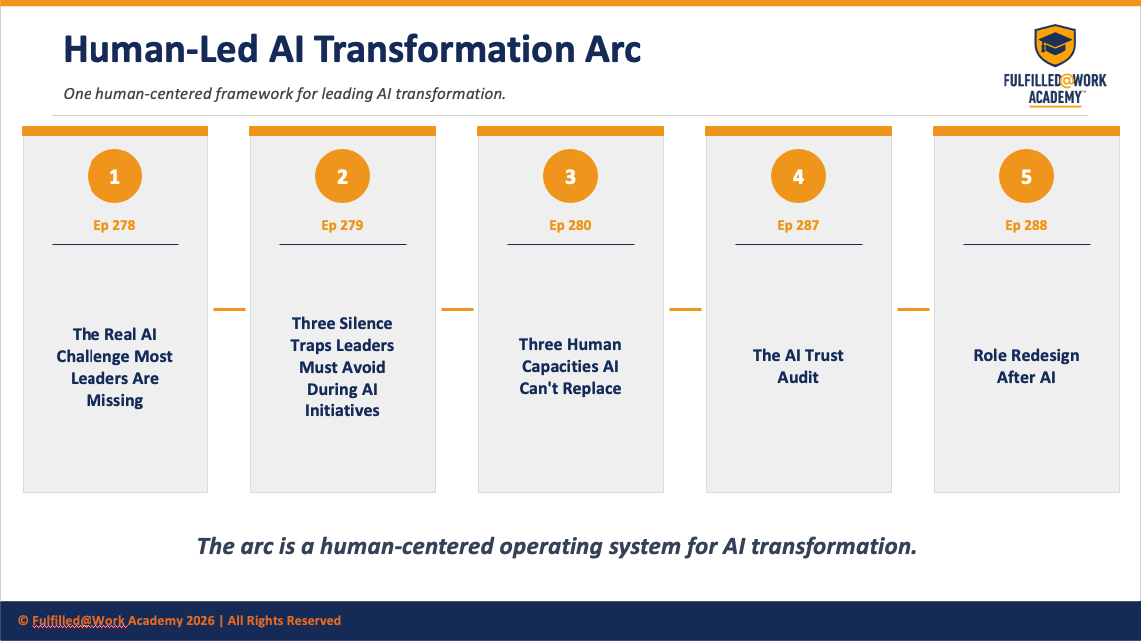
The Human Led AI Transformation Arc | Bernie Borges | Fulfilled@Work Academy

5 Key Takeaways:

Efficiency Without Purpose Is Just Speed:
AI can help teams do more in less time, but that does not automatically make work better. If the only goal is output, your people may end up just as stretched as before only faster. Fulfillment Centric Leadership™ asks a different question: what should this newfound capacity make possible for the people doing the work and for the business they serve?

The Human Dividend Must Be Designed:
When AI removes repetitive or draining tasks, that freed-up capacity will go somewhere. In many organizations, it gets immediately refilled with more meetings, more tasks, and higher output expectations. In organizations led with intention, that capacity becomes space for deeper human contribution — creativity, judgment, relationships, and meaning-making. The difference is not the technology. It is the leadership.

The Energy Audit Reveals What AI Should Actually Improve:
Not all work affects people the same way. Some tasks energize them, while others drain them. Asking, “If we removed the three most draining tasks from your week, what would you want to spend that time on instead?” opens a design conversation. The answers reveal what your people value, where their energy lives, and how AI can be deployed to improve the work experience, not just the workflow.

Contribution Is Bigger Than Task Completion:
The contribution conversation asks, “What is the contribution you want to be known for in this organization?” This shifts the focus from tasks to impact. It helps leaders understand the human capacities each team member wants to develop, judgment, creativity, relationship-building, strategic thinking, and what kind of leadership support they need as AI changes the shape of their role.

Future Roles Should Be Co-Designed, Not Announced:
The future role conversation gives leaders a practical way to connect AI implementation to individual growth. By saying, “Here’s what I see AI handling in your workflow over the next three to twelve months, and here’s where I believe your unique contribution becomes even more critical. Does that match what you want?” leaders invite alignment instead of imposing change. This is what separates leaders who retain their best people through AI transformation from those who wonder why their best people disengaged or left.

Main takeaway:
AI will do what you ask of it. The question is whether you are asking the right thing. If you use AI only to do more of the same, you will get more of the same, just faster. But if you use AI to redesign the conditions under which your people work, you can free them to do the work that actually fulfills them while still moving the needle on business results. That is the Human Dividend. It is the difference between an AI transformation and a leadership transformation, and the leader is the deciding variable.

📅 Book a Complimentary Strategy Session with Bernie

Life Fulfilled Podcast host and Fulfilled@Work Academy CEO, Bernie Borges, offers a complimentary strategy session. Schedule yours here: https://calendly.com/fulfilled-at-work/employee-20-minute-strategy-call

Get the Life Fulfilled newsletter delivered to your inbox weekly. Some creators charge for their newsletter. My newsletter is free! Subscribe here. https://fulfilledatworkacademy.com/newsletter/

About Fulfilled Leadership:
The Fulfilled Leadership YouTube channel helps growth-stage leaders replace burnout, disengagement, and turnover with a fulfillment-based operating system without sacrificing results. If you are a founder, CEO, or leader running a company with 100–3000 employees, you are in the right place.

📣 Connect With Bernie Borges

👍 Like this video if you’re rethinking how you lead your team.
🔔 Subscribe to the Fulfilled Leadership YouTube channel
👉 Learn more at FulfilledAtWorkAcademy.com

Want to know more about Fulfillment Centric Leadership™?
https://fulfilledatworkacademy.com/ 

Connect with Bernie Borges
Website: https://fulfilledatworkacademy.com/
LinkedIn: https://www.linkedin.com/in/bernieborges/ 
Instagram: https://www.instagram.com/bernieborges/
TikTok: https://www.tiktok.com/@bernieborges  
Speaking: https://fulfilledatworkacademy.com/speaking/ 

“I record and produce my podcast in Riverside. I would use it even if I never recorded another episode. It’s an AI-powered platform for studio-quality recording (even on Zoom-style calls), plus ridiculously easy editing, transcription, and instant social clips. If you run webinars, record trainings, or want cleaner audio/video for meetings, take a look at my Riverside affiliate link.”

  • Bernie Borges, Host, The Life Fulfilled Podcast

Episode Transcript

Bernie Borges [00:00:00]:
This episode is also available on my fulfilled leadership YouTube channel. The link is in the show Notes. In the previous episode, I gave you the AI Trust Audit, which are five questions to surface the fears that your team isn’t saying out loud. If you haven’t watched that one yet, I suggest you go back and watch that one first. This episode picks up right where that other one left off. Because here’s the question that I get. After leaders run the trust audit, they say, okay, Bernie, now what? My team told me what drains them. They told me what makes them feel human.

Bernie Borges [00:00:38]:
They told me what they do with five more hours a week. Now, what do I actually do with this information? That’s what this episode is about. I’m Bernie Borges, CEO of Fulfilled at Work Academy, and today I want to talk to you about the leadership opportunity that most AI transformation plans completely skip over. It’s what I call the Human Dividend. If this resonates, subscribe to my channel. And now, let’s get into it. Now, the Human Dividend isn’t just another buzzword. It’s the most important thing that you’ll do after the AI rollout.

Bernie Borges [00:01:25]:
And almost nobody’s talking about it. Every AI pitch that I’ve ever heard promises the same thing. Efficiency. You’ll do more and less time. Your team will handle more volume. Your margins will improve. And maybe all of that is true, at least in terms of the technology capabilities. But here’s the question that never appears in those pitch decks.

Bernie Borges [00:01:52]:
Efficient toward what? Because if all AI does is let your already stretched team get more work done, well, they’ll still be stretched, just faster. And you haven’t solved anything. You’ve just accelerated the problem. And I’ve seen this happen. Leaders implement AI thoughtfully. The technology works exactly as promised, usually. And six months later, their engagement scores are even lower than when they started. Why? Because efficiency without purpose isn’t a strategy.

Bernie Borges [00:02:31]:
It’s just speed. Now you probably see where I’m going with this. When AI removes a layer of repetitive or draining work from your team’s weak One of two things happens in organizations without intentional leadership. That freed up capacity gets immediately refilled with, you guessed it, more tasks, more meetings, more output expectations, and the team is just as stretched as before. They have fancier tools, but a bigger to do list. Now, in organizations where leaders are intentional, where they’ve done the trust audit that I covered in the previous episode, and they’ve actually listened to the answers, that capacity becomes something different. And here’s the magic. It becomes the space for the work that only humans can do.

Bernie Borges [00:03:28]:
Judgment, creativity, deep relationships, meaning making. That’s the human dividend. And whether your team is ever actually experiencing it depends entirely on you. So what does this look like? I bet that’s what you’re thinking, right? Well, here are three conversations that can change everything. AI is reshaping every workplace. But most transformations fail because they ignore the human side of change fulfilled at work. Academy’s four move framework helps leaders reduce fear, create clarity, preserve meaning, and build adaptability. So your people don’t just survive AI change, they thrive in it.

Bernie Borges [00:04:14]:
And you get the outcomes you need if you’re a leader. Navigating this right now, let’s talk. Book a complimentary discovery call and let’s explore what human led AI transformation looks like for your organization. The link is in the show notes. We’d love to connect and I want to give you these three specific conversations to have with each person on your team as you’re moving through AI implementation. These are not performance reviews. They’re not job description rewrites. These are leadership conversations.

Bernie Borges [00:04:48]:
The kind that determine whether your people feel like they’re building something or being managed through something. So here we go. Conversation 1. This is the energy audit. This conversation starts with a simple premise that most leaders never state out loud. Not all work is created equal. Some tasks energize your people, some drain them. AI tends to be excellent at handling the draining work.

Bernie Borges [00:05:17]:
You know, the repetitive stuff, the routine, the mechanical. Which means a well led AI implementation should fundamentally change the energy profile of your team’s week. Now, the question to ask is, if we remove the three most draining tasks from your week, what would you want to spend that time on instead? You’re not going to make a promise here. You’re opening a design conversation. And what you hear in that conversation, if you really listen, will tell you more about how to deploy your AI investment than any vendor demo ever will. Pay attention to what lights people up when they answer this. That enthusiasm is data. Question 2.

Bernie Borges [00:06:02]:
This is the contribution conversation. This is the one that a lot of leaders avoid because it feels vulnerable to have. But it’s the most important conversation in the sequence. The question what’s the contribution that you want to be known for in this organization? Not the tasks you complete, but the impact you create. This conversation does two things. First, it surfaces the human capacities that your team member most wants to develop. Things like judgment, relationships, the creative thinking that AI can support but will never replace. Second, it tells you what kind of leader they need you to be for them as those capacities become more prevalent in their role.

Bernie Borges [00:06:50]:
This is fulfillment centric leadership. In practice, you’re not managing a headcount. You’re developing a person around their highest potential contribution. And when people feel that from their leader, the dynamic shifts in ways that no engagement survey can ever measure. Conversation 3. This is the future role conversation. Once you understand what energizes someone and what they want to contribute, you’re ready for the most practical conversation of the three. The question goes something like this.

Bernie Borges [00:07:24]:
Here’s what I see AI handling in your workflow over the next three to 12 months. Here’s where I believe your unique contribution becomes even more critical. Does that match what you want? Notice what this question does. You’re not announcing a restructure. You’re not co designing a future. You’re asking for their input on whether it aligns with their own aspirations. That’s a fundamentally different approach that most leaders don’t take. This conversation is what separates leaders who retain their best people through an AI transition from those who wonder six months later why those same people either quietly quit or just left to go somewhere else that felt more intentional about their growth.

Bernie Borges [00:08:15]:
How you execute these three conversations will look different depending on whether you’re leading 10,000 people, 100 people, or 10 people. The scale changes the logistics of course, but not the intent. Now let’s talk about the fulfillment centric lens. I want you to zoom out for a moment because I think there’s a frame that’s worth naming explicitly. The dominant narrative around AI and organizations right now is about efficiency. Doing more with less. And look, I am not against efficiency. Efficiency is good, but efficiency is a means, not a meaning.

Bernie Borges [00:08:54]:
If you lead your team through an AI transformation with efficiency as the automation only goal, you might hit your numbers, but your people might also feel emptier for it. And I’ve seen this happen. Fulfillment centric leadership says something different. It says that the real goal of removing friction and automating the routine is to free your people to do the work that actually requires them. Their humanity, the work that develops the their judgment, deepens relationships, connects them to something bigger than a task list. That’s the human dividend. It’s not a soft idea. It’s a leadership strategy.

Bernie Borges [00:09:39]:
And the leaders who are doing it, who are having these three conversations, who ran the trust audit before the rollout, who are treating this transition as a people movement, not just a technology moment. Those are the leaders who are building organizations that don’t just survive AI transformation. They’re creating a new standard that everyone in the organization aligns with so here’s what I want you to walk away with from this episode. AI will do what you ask of it. The question is whether you’re asking the right thing. If you use AI to do more of the same, you’ll get more of the same, just faster. But if you use it to redesign the conditions under which your people work to free them to do the work that actually fulfills them while they’re moving the needle on the business results that you need, you’re building something that AI can’t replicate. You’re building a team that’s genuinely invested in what you’re building together.

Bernie Borges [00:10:47]:
That is the difference between an AI transformation and a leadership transformation. And you are the deciding variable. This episode wraps a series that began way back on. Maybe not that far back, but began back on episode 278, 279 and 280. Sort of like an AI and leadership identity trilogy. In those three episodes I covered the mindset challenge, the communication layer, the human capacities that AI can’t replace, the trust audit, and now the fulfillment design. So together, that’s the full arc. Now, if you want to take any of this from concept into action inside your organization, that’s what I can do.

Bernie Borges [00:11:38]:
And I can help. So let’s connect. I offer a complimentary strategy session. It’s a real conversation. It’s not a pitch where we look at your team, where your team is right now, and what your next leadership move could be. The link is in the show notes. If this series has been valuable, share it with a leader in your life who’s navigating an AI transformation. These conversations matter, and they’re better when more leaders are having them.

Bernie Borges [00:12:04]:
I’m Bernie Borges, CEO of Fulfilled at Work Academy. I’ll catch you in the next episode. Thanks for listening to the Life Fulfilled podcast. At Fulfilled at Work Academy, we help leaders build teams that feel valued, energized and committed before burnout or turnover ever show up. Through our fulfillment centric leadership workshops, coaching and Masterminds, we equip leaders to lead with both head and heart because fulfilled leaders build high performing cultures. Visit fulfilledatworkacademy.com to learn more. And remember, fulfillment isn’t a soft skill. It’s a strategic skill.

Bernie Borges [00:12:46]:
It’s a performance strategy. I’m Bernie Borges, your fulfillment architect. Until next time, I wish you a life fulfilled.

FREE DOWNLOAD

The Midlife Career Reboot Workbook

Subscribe & Listen on

Get the Midlife Fulfilled Podcast
Delivered to Your Inbox

Each episode is curated with love.

Your information is 100% secure and will never be shared with anyone. You can unsubscribe at any time.